

Upgrading to a new phone often raises another question: Do you also need a new 5G SIM card? Some people assume a 5G phone automatically works on a 5G network, while others aren’t sure whether their current 4G SIM is already compatible or if switching to a new SIM will improve performance.
Read on to find the answers to common questions like what a 5G SIM card is, how it compares with a 4G SIM, how to check whether your current SIM supports 5G, and where to get one.
1. What Is a 5G SIM Card?
A 5G SIM card is a Subscriber Identity Module that allows a compatible phone to access a carrier’s 5G network.
Like any SIM card, it stores your subscriber information, authenticates your device, and enables services such as calling, texting, and mobile data.
Although many newer SIM cards support both 4G LTE and 5G, access to a 5G network also depends on having a compatible phone, a carrier that offers 5G service, and coverage in your area.
Simply inserting a 5G SIM into an older phone won’t automatically provide 5G speeds.

How a 5G SIM Card Works
Once activated, a 5G SIM card securely connects your phone to your carrier’s network and identifies your mobile account.
With a compatible device and an eligible plan, you can:
- Access 5G mobile data where coverage is available
- Make and receive voice calls
- Send and receive text messages
- Stream high-definition video
- Download large files more quickly
- Use cloud-based apps, online gaming, and video conferencing with lower latency
When 5G coverage isn’t available, most phones automatically switch to a 4G LTE network so you can stay connected.
Is a 5G SIM Card Different From a 4G SIM?
Physically, there’s little difference between a 4G SIM card and a 5G SIM card. The biggest distinction is compatibility with newer network technologies and the carrier’s provisioning.
Many carriers now issue universal SIM cards that support both 4G LTE and 5G. If your SIM is relatively new, you may not need to replace it when upgrading to a 5G phone.
However, older SIM cards issued years ago may not support all of your carrier’s latest 5G features, so it’s worth checking before making the switch.
2. Should You Use 5G or 4G SIM Cards?
For most people, both 4G and 5G provide reliable calling, texting, and internet access. The better choice depends on your device, local coverage, data usage, and budget rather than simply choosing the newest technology.
Here’s a quick comparison:
| Feature | 4G SIM Card | 5G SIM Card |
| Best for | Everyday use, older phones, budget plans | New smartphones, heavier data use, faster downloads |
| Device required | 4G LTE phone | 5G-compatible phone |
| Network coverage | Widely available | Expanding rapidly but varies by location |
| Performance | More than enough for browsing, streaming, video calls, and social media | Faster downloads, lower latency, and improved performance in congested areas |
| Cost | Often available with lower-cost plans | May require a 5G-compatible plan depending on the carrier |
For many users, a 4G SIM card is still an excellent choice because LTE easily handles everyday activities such as streaming HD video, video calling, navigation, and web browsing.
However, upgrading to a 5G SIM card may be worthwhile if you:
- Recently purchased a 5G smartphone.
- Live in an area with strong 5G coverage.
- Frequently download large files or stream high-resolution content.
- Use your phone as a hotspot or for bandwidth-intensive work.
The good news is that you don’t necessarily have to choose one forever. Many carriers now provide SIM cards that support both 4G LTE and 5G, allowing your phone to connect to the fastest available network automatically.
Globally, 5G adoption continues to accelerate, but 4G remains the most widely used mobile technology.
According to the latest Ericsson Mobility Report, 5G subscriptions surpassed 3.1 billion during the first quarter of 2026, while 4G LTE still accounted for nearly 4.6 billion subscriptions worldwide.
Ericsson also projects that 5G will overtake 4G as the dominant mobile access technology by subscription by the end of 2027.
3. How to Check If You Have a 5G SIM Card
If you’re unsure whether your current SIM supports 5G, you can usually find out in just a few minutes.
Check Your Phone Settings
Start by checking your network settings.
- Android: Go to Settings > Network & Internet > SIMs or Mobile Network.
- iPhone: Go to Settings > Cellular > Cellular Data Options.
If you see network options such as 5G Auto, 5G On, or 5G Standalone (depending on your carrier), your phone likely supports 5G. If your phone only shows LTE or 4G options, either your device, SIM, or carrier plan may not currently support 5G.
Check With Your Carrier
Your mobile carrier can quickly confirm whether your SIM card is 5G-compatible.
You can usually check by:
- Logging into your online account
- Using your carrier’s mobile app
- Visiting a retail store
- Contacting customer support
If your SIM card is outdated, your carrier may replace it at little or no cost.
Check Your SIM Card Information
Some carriers print the SIM generation or model number on the SIM card packaging or include this information in your online account.
If you received your SIM several years ago, especially before your carrier launched 5G service, it may be worth asking whether a newer SIM is recommended. Even if your current SIM still works, replacing an older SIM can help ensure compatibility with the latest network features supported by your carrier.
4. Where to Get a 5G SIM Card
Whether you’re switching carriers, upgrading to a 5G phone, or replacing an older SIM, there are several ways to get a 5G SIM card.
The best option depends on whether you want in-person assistance, the convenience of online ordering, or a free plan through a government assistance program.
Mobile Carriers and Retail Stores
Most major wireless carriers offer 5G SIM cards at their retail stores and authorized dealers.
Visiting a store allows you to:
- Activate your service immediately
- Transfer your existing phone number
- Verify that your phone supports 5G
- Get help installing and activating your SIM card
- Compare available plans before signing up
If your current SIM is several years old, store representatives can also confirm whether replacing it is recommended.
Online SIM Card Providers
Many carriers and mobile virtual network operators (MVNOs) allow customers to order 5G SIM cards online.
Ordering online is often the fastest option if you already know which carrier you want to use. Most providers ship the SIM card with activation instructions, and many allow you to complete the activation process entirely online.
Before placing an order, make sure:
- Your phone supports 5G.
- Your device is unlocked if you’re changing carriers.
- The carrier offers 5G coverage where you live.
Free 5G SIM Cards Through Authorized Lifeline ETCs
If you’re looking for a lower-cost option, you may qualify for a free 5G SIM card through the federal Lifeline program.
Lifeline is a federal assistance program administered by the FCC that helps eligible low-income households afford phone and internet service. Rather than purchasing service directly from the government, eligible consumers enroll through participating providers.
These participating providers are known as Eligible Telecommunications Carriers (ETCs). An ETC is a wireless or wireline provider authorized to offer Lifeline-supported services in a particular state.
Depending on the provider and network availability, eligible customers may receive:
- A free 5G-compatible SIM card or eSIM
- Free monthly talk and text
- Monthly high-speed data
- No annual contracts
- No hidden monthly fees
You may qualify if you meet either of the following requirements:
Program-based eligibility
You participate in a qualifying government assistance program, such as:
- Medicaid
- SNAP (Food Stamps)
- Supplemental Security Income (SSI)
- Federal Public Housing Assistance (Section 8)
- Veterans Pension or Survivors Pension
Income-based eligibility
Your household income falls at or below 135% of the Federal Poverty Guidelines, depending on your state and the applicable program rules.
One of the best-known authorized Lifeline ETCs is AirTalk Wireless. Eligible customers can receive free monthly talk, text, and data, along with a free 5G-compatible SIM card or eSIM.
Depending on eligibility, state availability, and inventory, AirTalk may also offer discounted smartphones from popular brands, making it a convenient option for users upgrading to 5G service.
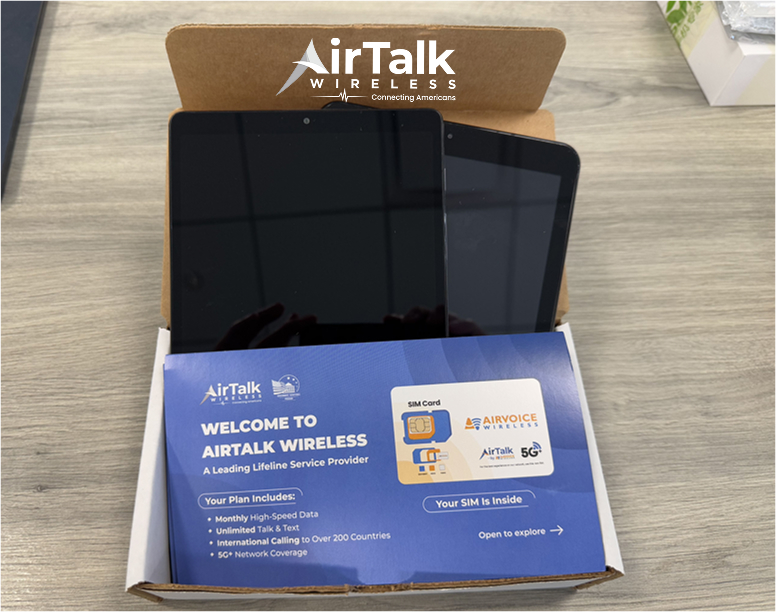
The application typically follows these steps:
- Visit the AirTalk Wireless website and start the application.
- Enter your ZIP code, select “Apply Now,” and choose the Lifeline plan that best fits your needs.
- Choose an available smartphone or continue with a compatible device if you only need a SIM or eSIM.
- Confirm your eligibility through your household income or participation in a qualifying assistance program.
- Upload proof of eligibility if additional documentation is requested.
- Submit your application and wait for an approval decision.
Read more: How Do I Know If My Phone Has a SIM Card? Seamless Ways to Check Any Device
5. FAQs
Can I use a 5G SIM card in a 4G phone?
Yes. A 5G SIM card can generally be used in a 4G-compatible phone. However, the device will connect to the 4G LTE network because it doesn’t have the hardware required for 5G.
Will a new 5G SIM card improve my signal?
Not necessarily. Signal strength depends primarily on your carrier’s network coverage and your phone. Replacing an older SIM may improve compatibility with newer network features, but it won’t increase coverage where a 5G signal isn’t available.
Can I transfer my existing phone number to a new 5G SIM card?
Yes. Most carriers allow you to keep your current phone number when activating a new 5G SIM card. This process is commonly called number porting.
Do I need a physical SIM card to use 5G?
No. Many newer smartphones support eSIM, which allows you to activate 5G service digitally without inserting a physical SIM card. Availability depends on your phone model and carrier.
6. Conclusion
A 5G SIM card helps compatible devices connect to the latest mobile networks, but upgrading isn’t always necessary. If you already have a newer SIM, a 5G phone, and coverage from your carrier, you may already be ready to use 5G. Before replacing your SIM, check your device compatibility, network availability, and service plan to determine whether an upgrade will provide meaningful benefits.
For eligible households, authorized Lifeline ETCs can also make 5G service more affordable by offering free monthly plans and 5G-compatible SIM cards.