
Choosing an eSIM in the United States sounds simple until you start comparing the options.
Some plans are built for tourists staying a few days. Others are designed for residents who need a long-term phone number and monthly service.
Add in major carriers, prepaid providers, travel eSIM companies, and government-supported programs, and it’s easy to feel overwhelmed before you’ve even activated a line.
If you are looking for e SIM USA information, our guide will break down everything you need to know: the major eSIM options available in the U.S., explains who they’re best suited for, and how ti choose a plan that fits your situation instead of paying for features you may never use.
1. What You Can Expect in an e SIM USA Plan

One of the biggest misconceptions about eSIM is that it’s a different type of mobile service.
In reality, an eSIM changes how you activate a plan, not necessarily what the plan includes.
Whether you’re using a traditional SIM card or an eSIM, you’ll still be choosing between the same types of services: talk, text, data, prepaid plans, unlimited plans, and international roaming options.
What makes eSIM appealing is convenience. Instead of waiting for a SIM card to arrive or visiting a store for activation, you can often download a plan directly to your device within minutes.
Depending on the provider, an eSIM USA plan may include:
- Talk and text within the U.S.
- Monthly high-speed data allowances
- 5G network access where available
- International roaming options
- Multiple lines on a single device
- The ability to switch carriers without swapping SIM cards
The exact features vary considerably from one provider to another, which is why it’s worth understanding the major players before choosing a plan.
2. U.S. Carriers That Fully Support eSIM
The good news is that eSIM is no longer a niche feature in the United States. Most major carriers now support eSIM activation on compatible devices, and many prepaid providers have followed suit.
Here’s a quick overview of some of the most recognizable options:
| Provider | eSIM Support | Best For |
| AirTalk Wireless | Yes | Eligible users seeking affordable or free service through Lifeline |
| T-Mobile | Yes | Broad 5G coverage and consumer plans |
| AT&T | Yes | National coverage and postpaid plans |
| Verizon | Yes | Extensive network reach |
| Google Fi | Yes | Frequent travelers and multi-network flexibility |
| Visible | Yes | Digital-first prepaid service |
| Mint Mobile | Yes | Budget-conscious users |
For most users, carrier choice comes down to three factors:
- Coverage where you live
- How much data you need
- How long you plan to keep the service.
Travelers often prioritize quick activation and flexibility, while long-term residents typically care more about coverage consistency and monthly costs.
3. eSIM USA for Visitors and Tourists
Not everyone needs a year-long phone plan.
If you’re visiting the United States for a vacation, business trip, conference, or short-term stay, your priorities are usually different from those of a permanent resident. Fast activation, enough data for navigation and communication, and avoiding expensive roaming charges tend to matter most.
Best Travel eSIMs for Short Trips
Travel-focused eSIM providers have become popular because they allow visitors to purchase a plan before arriving in the country.
Many travelers compare options such as Airalo, Nomad, Holafly, Ubigi, and Google Fi (for certain users).
These plans are often designed around a fixed number of days or a specific amount of data, making them useful for short stays.
Before purchasing, pay attention to:
- Data limits
- Coverage areas
- Hotspot support
- Validity period
- Whether a U.S. phone number is included
A cheaper plan isn’t always the better choice if it runs out of data halfway through your trip.
How to Activate Before You Land
One advantage of eSIM is that you don’t need to wait until you’re physically in the United States to get started.
Most providers allow activation before departure:
- Purchase the plan online.
- Receive a QR code or activation instructions.
- Add the eSIM profile to your device.
- Keep the line disabled until you’re ready to use it.
- Turn it on after arrival in the U.S.
Many travelers complete the entire setup process at home, which means their phone connects to a network shortly after landing instead of searching for a SIM card kiosk at the airport.
4. eSIM USA for Residents and Long Term Use
Tourist eSIMs are great for a few days or a few weeks. Once you’re living, working, or studying in the United States, however, your priorities start to change.
Instead of temporary data access, you’re usually looking for a stable phone number, predictable monthly costs, reliable coverage, and the flexibility to switch devices without disrupting service.
That’s where carrier-based eSIM plans become more attractive than travel-focused options.
Switching From Physical SIM to eSIM
Many U.S. residents still use physical SIM cards simply because that’s how their service was originally activated.
The good news is that moving to eSIM is often much easier than people expect. Most major carriers now allow customers to transfer an existing number from a physical SIM to eSIM through a carrier app, online account portal, or customer support request.
The biggest advantage is convenience.
Once the transfer is complete, there’s no SIM card to lose, damage, or replace when upgrading phones.
Future device changes can often be handled digitally, making the process much faster than waiting for a replacement SIM card in the mail.
Carrying Two U.S. Lines on One iPhone
Another reason eSIM has become popular is dual-line support.
Many recent iPhones can store multiple eSIM profiles and operate with two active lines at the same time.
This can be useful for people who want to separate work and personal calls, maintain a backup carrier, or combine a primary plan with a lower-cost data plan.
Instead of carrying two phones, users can manage both numbers from a single device.
5. The American eSIM Most Travelers and Residents Overlook
When people compare eSIM providers, they usually focus on major carriers and travel eSIM brands.
What often gets overlooked are government-supported programs that can provide ongoing service at little or no cost for eligible users.
Who Lifeline Covers Across All 50 States
Lifeline is a federal assistance program created to help qualifying households access affordable communication services.
Eligibility is generally based on household income or participation in programs such as:
- SNAP
- Medicaid
- Supplemental Security Income (SSI)
- Federal Public Housing Assistance
- Veterans Pension and Survivors Benefits
Participating providers operate across much of the country, making the program accessible to eligible users in all 50 states, Washington D.C., Puerto Rico, and several U.S. territories.
How to Activate a Free U.S. eSIM in One Sitting
AirTalk Wireless participates in the Lifeline program, providing eligible customers with free wireless service. Their plans usually include unlimited talk, text, and data with no monthly bills.
For compatible devices, activation can often be completed through eSIM, eliminating the need to wait for a physical SIM card to arrive.
The process typically looks like this:
- Confirm eligibility through income requirements or a qualifying assistance program.
- Visit the AirTalk Wireless website and check service availability.
- Verify that your device supports eSIM activation.
- Complete the online application and upload any required documents.
- Follow the activation instructions once approval is complete.
AirTalk also provides an eSIM Compatibility Checker, allowing users to confirm whether a device supports eSIM before beginning the application process.
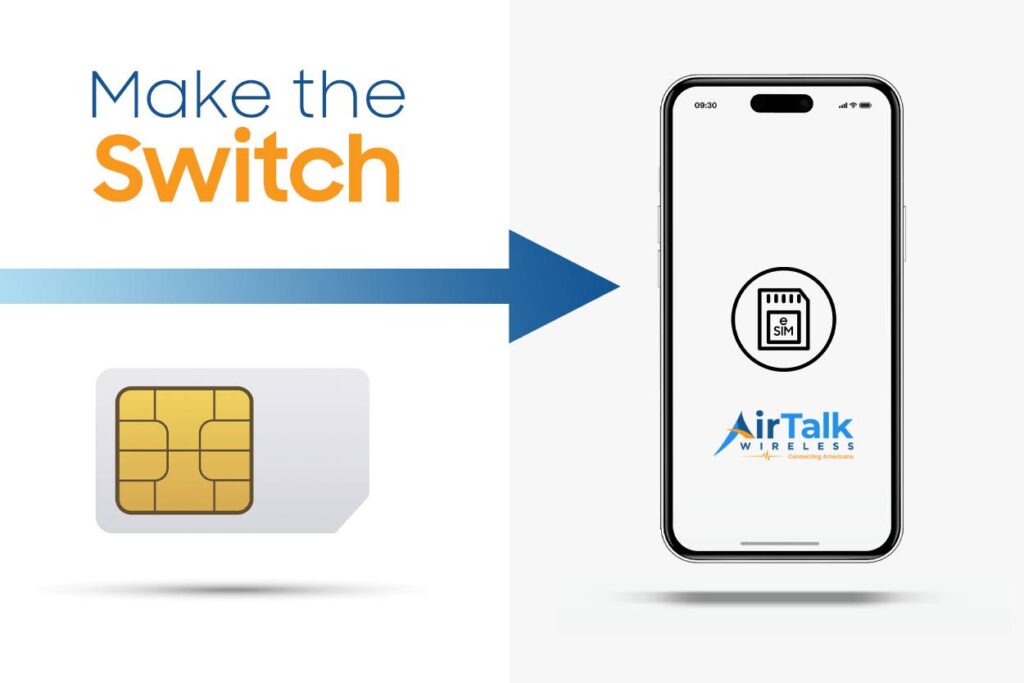
For people who qualify, this can be one of the simplest ways to activate ongoing U.S. mobile service without visiting a store or handling a physical SIM card.
Read more: How to Turn Off eSIM on iPhone and Android (2026 Guide)
6. FAQs
Does eSIM work everywhere in the United States?
eSIM itself doesn’t determine coverage. Coverage depends on the carrier’s network. If a carrier offers service in a particular area, an eSIM generally performs the same as a physical SIM on that network.
Can I use both eSIM and a physical SIM at the same time?
Yes. Many modern smartphones support dual-SIM functionality, allowing users to run an eSIM and a physical SIM simultaneously.
Is eSIM better than a physical SIM for travel?
For many travelers, yes. eSIM eliminates the need to buy, carry, or swap physical SIM cards and often allows service to be activated before arriving in the United States.
Can I switch back to a physical SIM later?
In most cases, yes. Many carriers allow customers to move service between eSIM and physical SIM formats, although the exact process varies by provider.
7. Conclusion
The hardest part of choosing an eSIM usually isn’t the activation process. It’s figuring out which option actually matches the way you’ll use it.
Some plans are built for people landing at the airport and needing data immediately. Others are designed for residents who want a long-term phone number, reliable coverage, and predictable monthly costs. Understanding that difference can save both money and frustration.
Hopefully, you now have a clearer picture of the e SIM USA landscape and feel more confident choosing a plan that fits your needs, whether you’re visiting for a few days or planning to stay much longer.